Tampilkan postingan dengan label books. Tampilkan semua postingan

Jumat, 18 April 2014

Replenishing a Sense of Wonder in Cities

  Tidak ada komentar
06.47

by Min Li Chan

In a radio interview with Eleanor Wachtel of Writers & Company, Gail Jones reflects upon urban experience and its centrality to her novel Five Bells. The conversation is insightful and eminently quotable, with many passages that threw new light on my old urbanist ways. Jones urges us to be aware not only of a city's physicality, but also of its intangible atmospheres:
I'm very interested in psychogeography, and the idea that we must walk around our own place with an active intelligence and a degree of radical attention to what is there. ... We ought not be the flaneur who is idly and languidly consuming the sights of the city, we must look at its shapes, at its motions, attend to its sounds, corridors between spaces, the unexpected things looming up or falling away as we turn a corner.


A painted alley in Sydney, Australia. Source: Zijun Roger Qian


Psychogeography is a balm for the jaded local, a way of revitalizing everyday urban experience. In Five Bells, Jones returns to Sydney's Circular Quay in an attempt to "defamiliarize a place that seems exhausted," one that is "eroded by tourism, evacuated of its wonder."


"Lighting of the Sails" at the Sydney Opera House near Circular Quay. Source: Dahlia Bock

As I grow accustomed to living in San Francisco, I fear getting desensitized to the city's quintessential sights and experiences. The heady discombobulation of travel and the novelty of distant places can evoke a sense of wonder that is easily overlooked in the cities we call home. Yet it's also possible to experience familiar places in new ways. In San Francisco there are events — from talks and walks to bicycle tours and treasure hunts — that delve into public art, food politics, vernacular history and other fascinating aspects of the city. This groundswell of hyperlocal resources from fellow urban dwellers helps to defamiliarize and rediscover everyday settings.


The Social Justice Mural Tour in San Francisco. Source: Thinkwalks

Jones also discusses Sydney's Demolition Books, an archival collection of "ghostly buildings that are no longer there, which you can look at and place with absolute precision where they were, where they sort of spoke from." She engages memorably with the roles of urban history in understanding and experiencing places:
There is both the vertical and the horizontal history, as it were, that we might attach ourselves to when we start to meditate on a city. ... There's the history that seems to be unfolding and moving forward, and there's the plunging down into the interiority of the place, into its lost histories.


A picture by Adam Forrest Grant of his son David at Circular Quay in the early 1900s. Source: City of Sydney Archive

Jones inspired me to contemplate how visual technologies might heighten the experience of historical artifacts like Sydney's Demolition Books. Imagine putting on a pair of augmented reality glasses to compare present cityscapes with detailed recreations in the same field of view. This brought to mind a recent brush with urban psychogeography in virtual reality. Outfitted with a Vive headset and handheld controllers, I suddenly found myself transported to my former neighborhood in Manhattan. Taking a few steps forward, I gazed up at skyscrapers rendered by Google Earth. Pixelated walls betrayed their virtuality, but the experience was nonetheless breathtaking. I zoomed out and looked down at the tops of buildings — feeling a bit like King Kong, perhaps — until they faded into a swath of planetary blue and green. In our near future, could virtual reality accentuate the wonders to be found in actual city streets?

+ share

Read More

Jumat, 15 November 2013

Inequality and Agitation in the Global City

  Tidak ada komentar
03.43

by Deen Sharp


Trenton Oldfield in the River Thames. Source: The Independent

In 2012, Trenton Oldfield threw himself into the River Thames to protest elitism in Britain. Oldfield intentionally timed his leap to disrupt the annual boat race between Oxford and Cambridge, yet he may have underestimated the British establishment's love of sport. His act provoked a starkly revanchist reaction: he was sentenced to six months in prison and deemed unwelcome to continue living in the United Kingdom. He is now fighting deportation to Australia.

Oldfield and his partner, Deepa Naik, are the founding directors of This Is Not A Gateway (TINAG) and Myrdle Court Press, which serve as platforms for examining and transforming cities. They recently published the third volume of their book series Critical Cities: Ideas, Knowledge and Agitation from Emerging Urbanists, which features writing and images by an international group of contributors from a wide variety of fields.


The volume has four sections: Erase, Stretch, Relinquish; Archipelago; Agency; and Stratification. Archipelago and Stratification are the strongest and most enjoyable, in my view. Archipelago is about the "avant-garde spaces of modern capitalism." The authors feature surprising uses of financial districts in Hong Kong, Cyprus and London, with emphasis on the social, cultural, economic and political relations within them.


Source: "People of Corabstos," a photographic essay by Jhon Arias in Critical Cities, Volume 3

"Pink: The Art of Being Confident," a photographic essay by Oldfield and Nanna Nielsen, is a fun and prescient analysis of the City of London in 2006. Alongside pictures of people wearing pink shirts to work, the authors share their reflections: "We wondered if the 'the City' [sic], despite being awash with scientific graphs and business models, was still dependent on the emotion of confidence." Nielsen and Oldfield capture this confidence in thirteen portraits, finding in the pink shirts a "symbolic 'canary in the mine'" for cities today.


Source: "Pink: The Art of Being Confident," a photographic essay by Nanna Nielsen and Trenton Oldfield in Critical Cities, Volume 3

In Stratification, the reader is taken past the confidence of the global city: "Underneath the promises (and experience) of democracy, efficiency, creativity and endless 'possibilities' lie some worrying unintended consequences." This section highlights related inequalities in Beirut, Bogotá, Zagreb and London, behind the corporate gloss of a "globalising neoliberal machine."


Source: "People of Corabstos," a photographic essay by Jhon Arias in Critical Cities, Volume 3

Fadi Shayya, Fouad Asfour and Lana Salman give a detailed account of the ways in which violence, sectarianism and political economy intertwine to shape — or deform — public space in Beirut. They assert that "conflict is still there in all its different forms: political, sectarian and armed; new traumas seem to sustain the everyday, and the geopolitically divided spatiality of sectarian geography persists and increases." In keeping with the book's theme, the authors offer a critique and call to action in shaping their city's development from below.


Source: "People of Corabstos," a photographic essay by Jhon Arias in Critical Cities, Volume 3

Agitation against the abuse of power is one of Critical Cities' central themes, but the editors' political analysis is all too frequently agitating. The book is littered with hyperbole: "everyone alive today knows it is possible to overthrow regimes" and "the axis of evil — capitalists, the military and religious leaders," to name a few. Added to this are some blatantly inconsistent attacks; Oldfield and Naik call academics to task for "flying around the world networking with one another," only to later boast that a London TINAG festival attracted participants from "across the planet."

The passion that inspired Oldfield to leap into the Thames is present throughout the collection, and has both a positive and a negative impact. This is an impatient book, bursting with cutting insights and calls for action. The sweeping arguments and sense of urgency, however, create a maelstrom characteristic of the "neoliberal" city at the center of its critique. We are taken from one place to another in a rush of global capital flows. There will surely be a new volume displacing this one, then on to the next — the regime expands, the city is interrogated, and all that is solid melts into air.

Deen Sharp is a doctoral candidate in the Department of Earth and Environmental Sciences at the City University of New York.

+ share

Read More

Sabtu, 06 Juli 2013

Informality and Injustice in the Resilient City

  Tidak ada komentar
06.47

by Andrew Wade


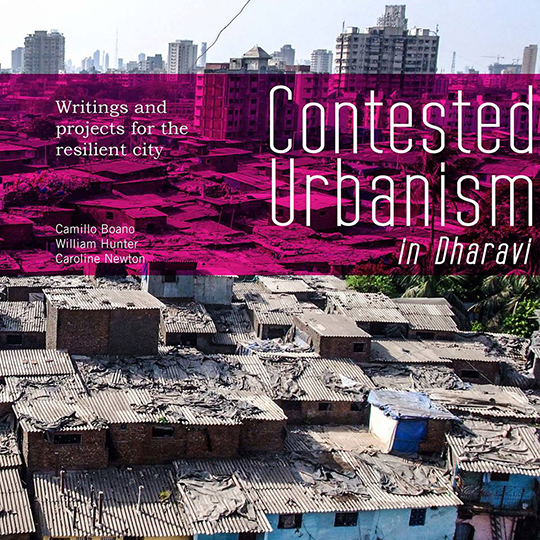
William Hunter is an architect, urban designer and teaching fellow at The Bartlett Development Planning Unit (DPU), University College London. I recently caught up with him to discuss his new book, "Contested Urbanism in Dharavi: Writings and Projects for the Resilient City," a collaboration with Camillo Boano and Caroline Newton. Dharavi — perhaps the most famous informal settlement in the world — has featured on Polis many times and we're excited to return via William's experience.

How did this project come about?

The book is a culmination of work dating back to May of 2009, when a group of students from the DPU's Building and Urban Design in Development program travelled to Mumbai for a three-week research trip. Professor Camillo Boano led the project in collaboration with SPARC, an Indian NGO focused on housing and infrastructure for the urban poor. I was a student in the course, and for most of us it was the first time we'd encountered such extreme informality — from the harsh living conditions to the flourishing economic activity and political activism. This was an arena in which conflicting processes of empowerment and exploitation make comprehensive transformation seem unattainable.

Grappling with what we found in Dharavi from practical and theoretical points of view, we arrived at a studio module for the next three years. The attention and collective effort given during this time warranted proper documentation — compiling the group's research, reflections and project work into a single volume. Former students, DPU staff and many others helped us prepare the book for publication.


Why Dharavi?

There seemed to be thousands of microscopes pointed at this plot of land in central Mumbai with the powerful, if unsubstantiated, epithet "Asia's largest slum." Dharavi was at the tip of everyone's tongue — in academia, in the media, in works of non-fiction and fiction, even in cinema. Release of the movie "Slumdog Millionaire" earlier that year created a somewhat glamorized image of slum living that seemed worth interrogating. Our involvement was part of this wave of intrigue, but with a challenging objective.

The DPU had established longstanding relationships with SPARC, Homeless International and Slum-Dwellers International (SDI) as well as their national affiliate, the National Slum-Dwellers Federation (NSDF). We knew that we weren't the first student group to land in Dharavi, though we felt at the time — and still do — that we were approaching the situation differently from the way others had. We shared an affinity for the architecturally driven projects by groups from Columbia University and TU Berlin, but were focused more on studying the roots of social problems and the experience of local communities. We wanted to understand the power relations at play in "slum upgrading" plans in order to inform a participatory design process.


What did your group focus on?

What's interesting is that Dharavi isn't even Mumbai's largest slum, let alone Asia's. The peri-urban Mankhurd-Govandi and Dindoshi settlements, for example, have eclipsed Dharavi in size and estimated population. But because of Dharavi's prime location at a potential transit hub just south of the Bandra Kurla Business Complex, it's caught up in conflict over Mumbai's future development.

The Dharavi Redevelopment Project (DRP), a scheme proposed and managed by architect-consultant Mukesh Mehta following a report produced by McKinsey and Company in 2003, aimed to establish a foundation for transforming Mumbai into a "world-class city" free of informal settlements. Hypothetically, this would be a great thing; living conditions are dire, with an alarming lack of basic services. But the DRP involved suspect means of implementation: among the approximately 40,000 square feet of private residential and commercial space, each Dharavi household would receive only 270 square feet of resettlement housing, and only those who could prove that they'd lived in the settlement prior to the year 2000. The project threatened places of residence and employment. Its profit-driven approach placed residents on the defensive, rendering Dharavi a perfect storm of contested urbanism.


Would you say that contested urbanism is a new global phenomenon?

It's not a new phenomenon, but definitely global. The Occupy Movement is a viral example. It involves conflicts over local space that extend to conflicts over governing the commons at other scales, over access to local and global resources. Urbanism also involves reading and investigating a place. While it seems like a familiar idea, we attempted a more critical interpretation through the notion of contested urbanism. We wanted to unpack the many different and at times contradictory power relations at play in Dharavi. We were also thinking about how similar processes take place in other settings around the world, and how to confront them in theory and practice.


How did you confront these instances of local and global spatial conflict?

We examined relationships between space, politics and society. Our approach is rooted in Lefebvre's "production of space," Heidegger's "human spatiality" and Foucault's assertion that "space is fundamental in any exercise of power." We also drew upon Lefebvre's "right to the city" and the "critical regionalism" of Alexander Tzonis and Liane Lefaivre. These concepts shed light on conflicts between people and top-down control over urban development.

The inner conflicts of development practitioners required attention as well. When we visited Dharavi and began writing about it as a studio case study, a focus on contested urbanism helped us escape the tendency to think mainly in terms of design solutions. It served as an alternative way of thinking, of enriching the possibilities for critically assessing and acting within a highly complex urban setting.


Resilience comes up often in urban planning and design, often without much critical reflection. What role did it play in your project?

In the face of struggle for equality in the city, and certainly in the wake of natural and manmade disasters, the idea of resilience is very important. The ability of individuals and communities to address immense challenges is based on unwavering effort. We see this all over the world: in southern Louisiana — where I grew up — following Hurricane Katrina, in the massive rebuilding underway in Haiti. The list goes on and on. But the everyday resilience in Dharavi is unmatched in terms of DIY building and economic activity.

Almost everything in Dharavi is part of an informal process, from the sanitation systems to the electrical grids. There is a profound coping mechanism on display, with people adjusting to a severe lack of services and a precarious future. Yet Dharavi's streets are as vibrant and bustling as those of any "global city." You can find almost anything in its markets and much of the goods are actually produced locally. I remember an article in the Economist that estimated the value of annual production in Dharavi at $500 million, and much of it is sold outside the settlement. This activity in the midst of such unhealthy and unjust living conditions is evidence of profound resilience.


What is in store for Dharavi, and what implications might this have for addressing urban poverty worldwide?

In Dharavi, the latest news is that the DRP has been momentarily thwarted by grassroots opposition. The Indian Alliance (SPARC, NSDF and Mahila Milan) and the Special Advisory Committee of Experts appointed to "humanize" the DRP have contributed substantially to this effort. It is a great achievement, calling attention to the need for revising policies like the Slum Rehabilitation Act, which places unfair limits on eligibility for resettlement housing.

A parallel issue is recognition, which has always been an obstacle in Dharavi and other informal settlements. The government just doesn't know how many people live in these areas, as surveys quickly become outdated with the constant flow of urbanization. Securing accurate population data is a positive step toward upgrading infrastructure, housing and services.


Informal settlements place unique demands on mainstream planning. Their strengths and weaknesses have to be taken into account when approaching redevelopment. Projects like Homegrown Cities can help by supporting local solutions to housing development and preserving resident livelihoods.

Engagement with contested urbanism requires critical, inclusive and locally specific problem-solving. People will continue to overcome obstacles and outperform expectations. This is evident in Dharavi and in so many other settlements around the world. Informal resilience and DIY ingenuity show that cities can be built and governed from below. At the same time, slum residents require and deserve the same level of services that other members of society receive.

Advance copies of "Contested Urbanism in Dharavi: Writings and Projects for the Resilient City" can be purchased by sending an email to dpu@ucl.ac.uk.

Credits: Photos by William Hunter.

+ share

Read More